Why We Travel Far to Find Stillness and What We Miss at Home
The first thing I noticed was not the mountain, the sea, or the colour of the road at dusk. It was the silence around my phone.
No pings. No calendar alerts. No small red circles asking to be cleared. No quick check that became twenty minutes. The device was still in my pocket, but it had lost its authority. In that small, quiet place, where the day seemed arranged by weather, chores, meals, and the fading of light, I felt an almost physical relief.
It was not that life there stood outside the modern world. No place does. Plastic buckets, motorbikes, satellite dishes, imported snacks, and second-hand clothing already told a global story. Still, the rhythm felt different. People spoke without glancing down every few seconds. Children moved through public space without being tracked by apps. Time did not seem to arrive in fragments.
That feeling can be intoxicating for a traveller from a hyper-connected society. It can also be misleading.
The desire to find a “simple, unplugged” life in remote corners of the world says as much about us as it does about the places we visit. We arrive tired from speed, choice, and digital noise. We look outward for stillness. Then we risk turning other people’s daily lives into a cure for our own exhaustion.

Arrival feels like being released from a system
There is a particular kind of relief that comes with arriving somewhere quiet after living inside constant connection.
At first, it feels private. The body loosens. The mind stops scanning. A person notices small things again: the scrape of a chair on concrete, smoke lifting from a cooking fire, goats pressing their noses through a fence, the slow ritual of someone sweeping dust from a doorway.
In places where technology is less present, or less dominant, attention feels less divided. A conversation can stretch. Waiting does not automatically become scrolling. Boredom has room to become observation.
From a public sociology perspective, this is not only a personal mood. It is a social fact. Modern digital life changes how we use time, how we perform identity, and how we relate to one another. We are not only “online” when we open an app. We carry the expectation of availability. We live with the sense that every moment can be documented, improved, compared, or monetized.
So when a traveller reaches a remote village, an island with weak signal, or a mountain community where the internet comes and goes like weather, the absence of constant access can feel like freedom.
But freedom for whom?
The visitor reads the quiet as medicine. Local residents may read it as inconvenience, exclusion, or simply normal life. A bad road may look charming in a photograph, but it can make health care harder to reach. No signal may feel peaceful for a week, but it can isolate students, workers, and families. Candlelight may look beautiful at dinner, but unreliable electricity can limit opportunity.
This is where the romance of simplicity begins to fray.
The paradox of wanting a place to stay unchanged
Tourism is full of contradiction. I have felt sadness at seeing a quiet place transformed by guesthouses, tour signs, souvenir stalls, and cafés designed around foreign tastes. I have also been part of the demand that makes those changes happen.
The visitor does not arrive empty-handed. Even when travelling lightly, we bring systems with us.
We bring money shaped by global inequality. We bring expectations about comfort, safety, authenticity, and service. We bring cameras and phones. We bring reviews, maps, hashtags, and booking platforms. We bring the possibility that a place once known through family stories, trade routes, or local pilgrimage becomes known through search results.
Then we stand in the middle of that change and feel sorrow.
That sorrow may be sincere, but it can also be self-protective. We want the place to remain “real” for us. We want evidence that another way of living still exists, untouched by the forces that structure our own lives. We want to be comforted by the idea that not everywhere has become fast, branded, mediated, and measured.
Yet the act of visiting can help make the place more like the world we came from.
A footpath becomes a route. A home becomes accommodation. A meal becomes an experience. A ritual becomes content. The local craft becomes a product sized for luggage. The person becomes a host. The village becomes a destination.
This does not mean tourism is only harm. Tourism can bring income, pride, exchange, and political visibility. It can help younger people stay in their communities rather than leave for distant work. It can support language learning, small businesses, and infrastructure. Many communities actively choose to welcome visitors and shape tourism on their own terms.
The paradox sits in the middle: we may mourn the very transformation our presence helps fund.

Simplicity is not an aesthetic
The language of “simple living” can sound innocent. It often means less noise, less consumption, fewer screens, more presence. Many of us need that. The appeal is understandable.
Still, simplicity can become an aesthetic that outsiders place over other people’s lives.
A traveller might admire hand-washing clothes in a river without asking whether local families would prefer affordable washing machines. We might praise the lack of cars without asking about access to ambulances. We might celebrate a community’s distance from the internet while young people there are trying to apply for school, sell goods, talk with relatives abroad, or learn skills online.
A slower life is not always a chosen life. A low-tech life is not always a freer life. What appears peaceful to someone passing through may carry labour, limits, and fatigue for those who stay.
This does not cancel the beauty of quieter places. It asks for a more honest way of seeing.
There is a difference between appreciating a rhythm of life and turning it into a moral lesson. There is a difference between learning from less consumerist cultures and treating poverty, remoteness, or limited infrastructure as spiritual decoration. The first requires humility. The second turns inequality into ambience.
A community should not have to remain picturesque to satisfy the conscience of visitors.
The question is not whether technology, roads, schools, clinics, or reliable communication should arrive. Local people have the right to debate and desire those things for themselves. The deeper question is who controls the terms of that arrival. Who benefits? Who loses land, language, privacy, or power? Who gets to decide what should be preserved, adapted, or left behind?
Public sociology asks us to connect personal feeling to social structure. My longing for stillness is personal. The ability to travel far to find it is political. The encounter between those two facts is where the real reflection begins.
Globalization follows us into the quiet
Remote places are often described as if they exist outside globalisation. That is rarely true.
A fishing village may depend on fuel prices set far away. A mountain settlement may receive remittances from relatives working in cities or abroad. A traditional market may sell packaged goods made across oceans. A local dance may be performed for visitors whose flights add to the climate pressures already affecting harvests, coastlines, and water.
The “remote” is connected. It may simply be connected unevenly.
Globalisation does not spread like a smooth blanket. It arrives in fragments. A village may have smartphones before sewage. A community may have tourism before political representation. A family may have access to foreign television but not reliable medicine. Young people may know global music and slang while facing very local limits on work, land, and mobility.
This unevenness is easy for travellers to miss because we move through places selectively. We see what fits the story we need.
If we arrive exhausted, we notice calm.
If we arrive nostalgic, we notice tradition.
If we arrive guilty, we notice loss.
If we arrive hungry for meaning, we notice rituals, elders, children, meals, stars.
All of these things may be real. None is the whole place.
The ethical task is to resist making a community into a mirror. When we say, “People here are happier with less,” we may be describing something true. We may also be using other people to criticize our own society without doing the harder work of changing it.
That work begins by admitting that the stillness we seek abroad is often a response to conditions we have normalized at home.

The gaze can turn back toward home
Why do we need distance to become attentive?
Why does a meal feel more human when it is eaten on the other side of the world? Why do we notice laundry lines, doorways, birds, gestures, and weather while travelling, then ignore them on the street where we live? Why do we ask strangers abroad about their lives with curiosity, then reduce neighbours at home to background?
Travel changes perception because it interrupts habit. It makes the ordinary unfamiliar. We do not know the codes, so we watch. We do not know the route, so we slow down. We do not know the language perfectly, so we listen to tone, hands, pauses, and faces. The world sharpens because we have lost automatic control.
But must we cross a border to practise that kind of attention?
A city block in Toronto, Halifax, Winnipeg, Montreal, or a small town in northern British Columbia holds more social worlds than any of us can fully know. Apartment balconies, bus stops, corner stores, community centres, schoolyards, parks, laundromats, alley gardens, seniors’ benches, late-night diners, places of worship, and shoreline paths all contain forms of life we often pass without attention.
The issue is not that home lacks depth. It is that familiarity dulls us.
We confuse proximity with knowledge. We assume the nearby is already understood. We reserve wonder for elsewhere and analysis for crisis. Meanwhile, the longing that sends us across the world may be asking for something closer and more difficult: a different relationship to the place we already inhabit.
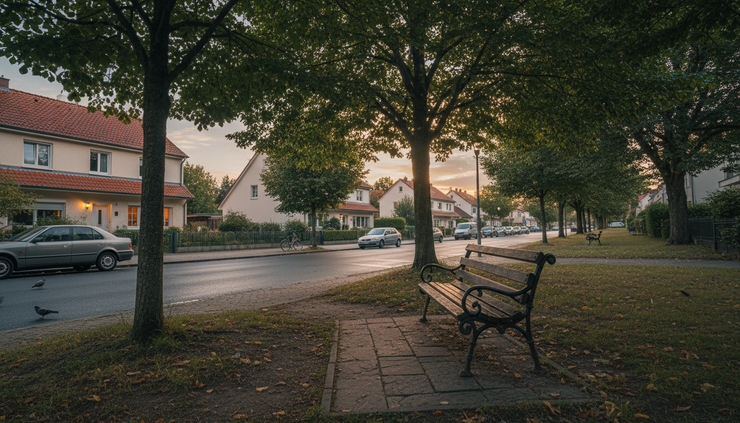
What would happen if we brought a traveller’s curiosity to our own street?
Not the consuming gaze that hunts for novelty, but a patient gaze. The kind that asks who cleans, who waits, who gathers, who is pushed out, who remembers what used to stand on that corner, who feels safe, who feels watched, who belongs without question, and who must keep explaining their presence.
Stillness is not only found where the Wi-Fi is weak. Human connection is not reserved for remote communities. Both can be practised through attention, time, and a willingness to be interrupted by other people’s realities.
The quiet we seek is also a social question
The desire to unplug is often framed as a lifestyle choice. Turn off notifications. Take a digital detox. Go somewhere remote. Walk more. Buy less. Be present.
These choices can help. They can make a day feel wider.
Yet the pressure to be constantly reachable is not just personal failure. It is built into work cultures, service economies, family expectations, school systems, and platforms designed to hold attention. Many people cannot simply disappear for a week. Many cannot afford silence. Their labour depends on being available, responsive, rated, visible, and flexible.
That means the search for stillness has a class dimension. It has a geography. It has a passport. It has a data plan. It has paid vacation, or it does not.
For travellers who can leave, the experience of quiet should not become only a private souvenir. It can become a question we bring back.
What kinds of communities allow people to rest?
What kinds of public spaces invite unhurried presence without requiring consumption?
What would our neighbourhoods look like if benches, libraries, parks, transit, local shops, and shared meals mattered as much as productivity?
What would change if we treated attention as a civic practice, not just a wellness goal?
These questions do not reject travel. They make travel more honest. To travel well is not only to collect places. It is to let places unsettle the way we live.
Coming home without closing the question
Travel can still matter. It can loosen certainty. It can teach scale. It can reveal that the way one society organizes time, family, work, food, age, faith, land, and memory is not the only way. At its best, travel makes us less provincial about our own assumptions.
The danger begins when we ask other places to save us from the life we continue to build at home.
A quiet village should not have to become a sanctuary for the digitally exhausted. A remote community should not have to remain unchanged so visitors can believe in authenticity. A person’s ordinary life should not be converted into someone else’s metaphor.
The relief we feel upon arrival is still worth taking seriously. It tells us something. It tells us that constant connection has costs. It tells us that many people are hungry for slower time, thicker relationships, and places not organized around display. It tells us that modern life often produces the very emptiness it then sells us escapes from.
But the more difficult lesson waits after the return.
Can we come home and look again? Can we notice the social life at the bus stop, the loneliness in the condo tower, the care work in the apartment next door, the informal economies, the elders on porches, the teenagers in parking lots, the newcomers remaking public space, the land beneath the pavement, the sky we stopped watching?
The stillness we travel far to find may not be a place. It may be a capacity we have allowed to weaken.
To recover it, we may need journeys. We may also need practice. A slower walk. A longer conversation. A phone left in a pocket. A question asked without rushing the answer. A willingness to see home not as the place we already know, but as the nearest unknown world.
Comments